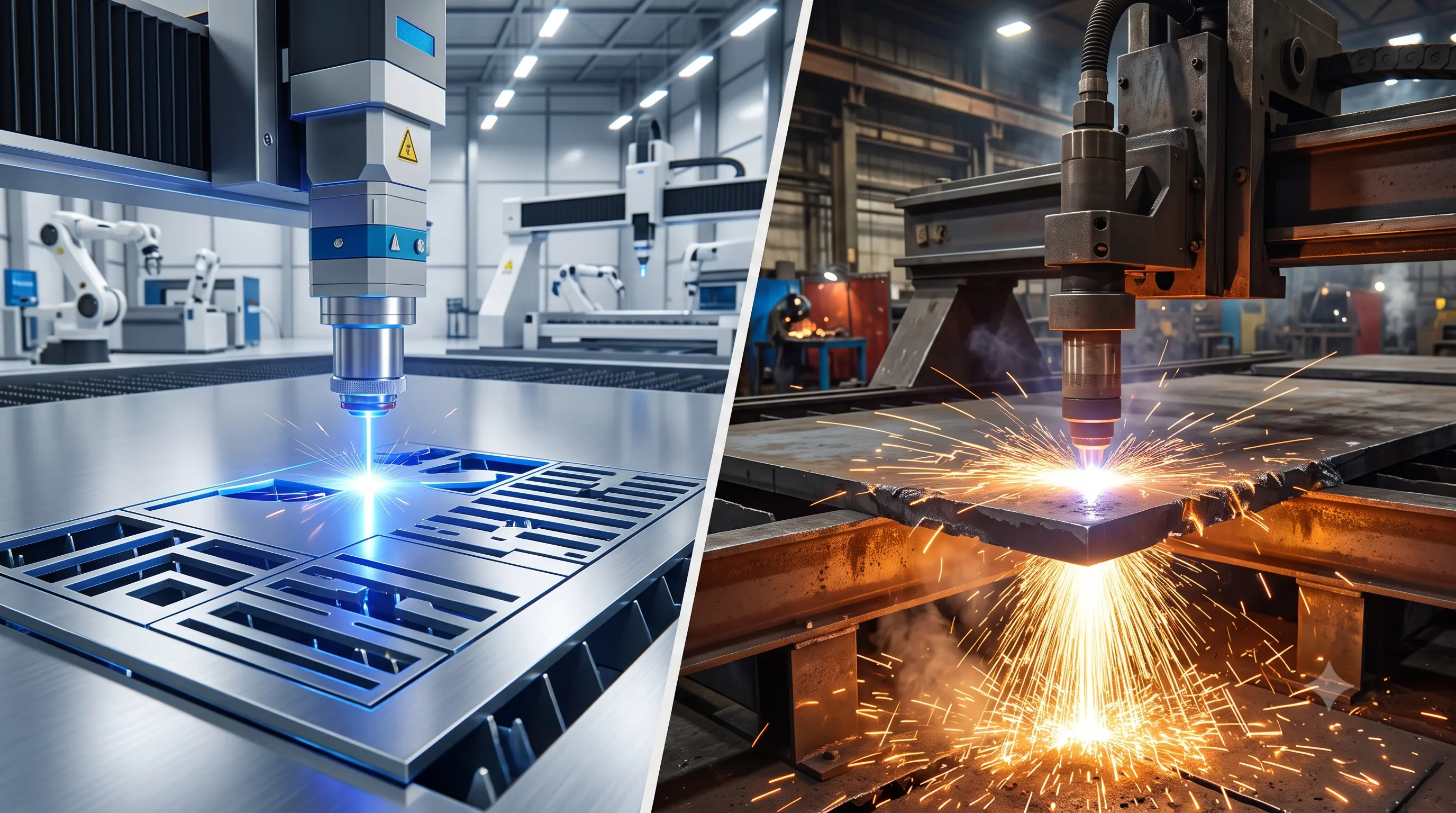
Laser Cutting vs Traditional Cutting: Which Is Better for Industrial Manufacturing?
Choosing the right metal cutting technology is an important decision in industrial manufacturing. The cutting method can affect accuracy, production speed, material utilisation, edge quality, repeatability, and overall manufacturing cost.
For OEMs, engineering companies, and industrial manufacturers, two broad approaches are commonly considered: laser cutting and traditional mechanical cutting methods such as shearing, sawing, punching, and similar processes.
So, which is better?
The answer depends on the material, component design, production volume, required tolerances, and application. However, for many modern industrial applications, CNC laser cutting offers significant advantages when complex designs, precision, repeatability, and flexible production are required.
What Is Laser Cutting?
Laser cutting is a manufacturing process that uses a focused laser beam to cut metal according to a digital design.
The laser melts, burns, or vaporises the material along the programmed cutting path. CNC-controlled movement allows the machine to follow complex profiles with high accuracy.
Laser cutting can be used for materials such as:
- Mild steel
- Stainless steel
- Aluminium
- Other compatible sheet metals
It is widely used for industrial components, brackets, panels, enclosures, machine parts, automotive components, and custom sheet metal products.
What Is Traditional Metal Cutting?
Traditional metal cutting includes several mechanical or conventional processes.
Depending on the application, these can include:
- Shearing
- Saw cutting
- Mechanical punching
- Guillotine cutting
- Drilling
- Manual cutting
These processes remain useful for specific applications, particularly where designs are simple, production requirements are predictable, or specialised cutting characteristics are needed.
Traditional cutting should therefore not be considered obsolete. Instead, the appropriate technology depends on the specific manufacturing requirement.
Laser Cutting vs Traditional Cutting
1. Cutting Accuracy
One of the major advantages of laser cutting is its ability to produce precise and repeatable profiles.
The CNC-controlled laser follows a programmed digital path, allowing complex shapes, holes, slots, and detailed profiles to be produced consistently.
Traditional mechanical processes can also provide accurate results, but accuracy depends heavily on the specific equipment, tooling, setup, and cutting method.
For components with complex geometries or tighter dimensional requirements, laser cutting can provide greater flexibility.
2. Complex Designs
Laser cutting is particularly useful when components contain intricate profiles or multiple cut-outs.
A single laser-cutting program can produce complex shapes without requiring a different physical cutting tool for every feature.
Traditional methods may require dedicated tooling, multiple operations, or additional setup when the design becomes more complicated.
This makes laser cutting especially useful for custom sheet metal fabrication and products that frequently undergo design changes.
3. Production Flexibility
Manufacturing requirements can change frequently.
A customer may require a new component design, different hole patterns, or modified dimensions.
With CNC laser cutting, changes can often be implemented by modifying the digital cutting program rather than manufacturing entirely new physical tooling.
This flexibility is valuable for:
- Prototyping
- Product development
- Custom components
- Engineering changes
- Small and medium production batches
- High-volume repeat production
Traditional cutting methods can be highly efficient for stable, repetitive designs, but tooling changes may make design modifications more complicated depending on the process.
4. Production Speed
Production speed depends on the material, thickness, geometry, quantity, and cutting technology.
For suitable sheet metal applications, modern laser cutting can provide fast processing while reducing the number of secondary cutting operations.
However, traditional methods can still be extremely efficient for simple, repetitive cuts.
For example, a conventional shearing process may be very effective when producing straight cuts in large quantities.
Therefore, the fastest method is not always the same for every component.
5. Material Utilisation
Material cost is an important part of manufacturing.
Laser cutting allows components to be arranged using computer-controlled nesting software to improve material utilisation.
Better nesting can reduce unused sheet material and minimise waste.
Traditional processes can also achieve efficient material usage, but the available nesting flexibility depends on the specific cutting method.
For manufacturers processing expensive materials such as stainless steel or aluminium, improving material utilisation can have a noticeable effect on overall production costs.
6. Edge Quality
The quality of the cut edge is another important consideration.
A properly configured laser-cutting process can produce clean and precise edges, reducing the need for additional finishing in many applications.
Traditional mechanical cutting methods can also produce good edge quality, but some processes may create burrs, deformation, or other characteristics that require secondary processing.
The actual result depends on the machine, material, thickness, tooling, and process settings.
7. Tooling Requirements
Traditional cutting methods often rely on physical tools, blades, dies, or other cutting equipment.
These tools can be highly effective for large production runs involving stable designs.
Laser cutting generally relies more heavily on digital programming rather than dedicated physical tooling for each component profile.
This can make laser cutting attractive for manufacturers producing multiple component designs or products that undergo frequent engineering changes.
8. CNC Automation and Repeatability
Modern CNC laser cutting can be integrated into automated production workflows.
Digital programs can control cutting paths and process parameters, helping manufacturers achieve consistent results across production batches.
Repeatability is particularly important for OEM manufacturing, where hundreds or thousands of components may need to match the same engineering specification.
Traditional cutting can also be automated, but the level of automation depends on the specific machinery and manufacturing process.
When Is Traditional Cutting Better?
Laser cutting is not automatically the best choice for every manufacturing application.
Traditional cutting may be more suitable when:
- The design consists mainly of simple straight cuts.
- Extremely high production volumes justify specialised tooling.
- The component requires a process specifically suited to mechanical cutting.
- Material thickness or geometry is better suited to another cutting method.
- Tooling costs can be efficiently distributed across a very large production run.
For simple, repetitive manufacturing, a traditional process can sometimes provide an efficient and economical solution.
When Is Laser Cutting Better?
Laser cutting is often a strong choice when the project requires:
- Complex profiles
- High dimensional accuracy
- Multiple component designs
- Rapid design changes
- CNC-controlled production
- Reduced tooling requirements
- Efficient material nesting
- Repeatable production
- Custom sheet metal components
This makes laser cutting particularly useful for modern OEM and industrial manufacturing.
Which Cutting Method Is More Cost-Effective?
There is no universal answer.
The total manufacturing cost depends on:
Material + Machine Time + Tooling + Labour + Setup + Secondary Operations + Production Volume
For a simple component produced in very large quantities, traditional cutting may be more economical.
For complex components, laser cutting may reduce tooling requirements, secondary operations, and production complexity.
Therefore, manufacturers should compare the total manufacturing cost, rather than simply comparing the hourly rate of individual machines.
Laser Cutting for Sheet Metal Fabrication
In modern sheet metal fabrication, laser cutting is often the first major manufacturing stage before bending and fabrication.
A typical production sequence may be:
Raw Material → Laser Cutting → CNC Bending → Fabrication → Surface Preparation → Powder Coating → Laser Engraving → Inspection
The exact sequence depends on the component and customer requirements.
Integrating laser cutting with other fabrication processes can help improve production coordination and consistency.
Why Choose Phoenix Fabricators?
Phoenix Fabricators India Pvt Ltd provides CNC laser cutting and sheet metal fabrication services in Pune for OEMs and industrial manufacturers.
The company’s capabilities include laser cutting, CNC bending, custom fabrication, powder coating, shot blasting, and laser engraving, allowing multiple manufacturing processes to be handled through an integrated production setup.
Phoenix Fabricators supports customers across India with Pan-India delivery and also serves international customers in Europe and Australia.
Its manufacturing capabilities support applications across industries including automotive, electronics and telecommunications, robotics, medical equipment, food and beverage, and industrial manufacturing.
Conclusion
So, laser cutting vs traditional cutting—which is better?
There is no single answer for every manufacturing project.
Traditional cutting remains valuable for simple and highly repetitive applications, while laser cutting offers significant advantages for complex profiles, precision components, flexible production, reduced tooling requirements, and repeatable CNC manufacturing.
The best approach is to evaluate the material, thickness, component design, production volume, tolerance, material utilisation, tooling requirements, and total manufacturing cost before selecting a cutting method.
For OEMs and industrial manufacturers, choosing an experienced sheet metal fabrication company in Pune can help determine the most suitable manufacturing process for each component.
Phoenix Fabricators combines laser cutting, CNC bending, custom fabrication, powder coating, shot blasting, and laser engraving, supporting industrial manufacturing requirements with Pan-India delivery and international supply to Europe and Australia.
Frequently Asked Questions
Is laser cutting better than traditional cutting?
Laser cutting can be better for complex designs, precision components, flexible production, and repeatable CNC manufacturing. Traditional cutting can be more suitable for simple designs and certain very high-volume applications.
Is laser cutting more expensive?
Not necessarily. While laser cutting equipment can involve significant investment, the overall manufacturing cost depends on material utilisation, machine time, tooling, production volume, setup, and secondary operations.
Is laser cutting suitable for high-volume production?
Yes. CNC laser cutting can be highly suitable for high-volume OEM production when the equipment, material, production planning, and process parameters are appropriate.
What is the main advantage of laser cutting?
One of the main advantages is the combination of precision, repeatability, design flexibility, and reduced tooling requirements.
Does laser cutting reduce material waste?
Laser cutting can improve material utilisation through computer-controlled nesting. The actual material savings depend on component geometry, sheet dimensions, cutting parameters, and nesting efficiency.